How to increase attention span naturally: the Phytomem One guide

Updated August 2026 · reviewed by the Phytomem Research Team. We are an independent information resource, not a medical provider, and this article is educational rather than medical advice.
To increase your attention span naturally means training focus in short, protected work blocks and removing the sleep, screen and stress leaks that fragment it — no stimulants required. It is a set of small, repeatable habits that let you hold your mind on one thing for longer, and a stimulant-free botanical such as Phytomem One can quietly support that routine rather than take its place.
How to lengthen focus without caffeine or willpower crashes.
- The goal
- Hold attention on one demanding task for longer, and return to it faster after a break — without stimulants.
- Biggest levers
- Timed work blocks and fewer distractions matter most, closely followed by real sleep and daily movement.
- The work-block rule
- Focus comes in waves; work in one 25-minute block on a single task, then take a short, genuine break.
- Where Phytomem fits
- Phytomem One is a stimulant-free daily botanical that supports the routine — it is not a treatment for any condition.
Attention is not a fixed trait — it is a skill that responds to how you structure your day. If you can only manage a few minutes before reaching for your phone, the problem is rarely willpower; it is usually an environment full of interruptions and a brain short on sleep. This guide walks through the practical, stimulant-free ways to lengthen focus — work blocks, sleep, screen habits and attention training — and where botanical Phytomem One plays a quiet supporting role.

What does it mean to increase your attention span naturally?
Increasing your attention span naturally is the practice of extending how long you can hold focus on one task using structure, rest and environment — not stimulants or force of will. Attention is a limited resource that refills with rest and drains with every interruption. Two ideas anchor everything below: attention comes in waves, not a flat line, and most gains come from removing distraction, not adding effort.
Why is my attention span so short in the first place?
A short attention span is usually the sum of ordinary, fixable pressures rather than a personal failing. The modern day is engineered to interrupt: phones buzz, tabs multiply, and every notification forces a costly restart. Layer on broken sleep, a sedentary routine and background stress, and even a motivated person struggles to stay on one thing. Each of those pressures is something you can adjust. Below are the levers with the most influence on focus for work, roughly in order of impact.
What are the most effective ways to lengthen focus?
1. Work in timed blocks, not open-ended slogs
The single most reliable way to increase focus is to stop treating attention as a flat, all-day resource and start working in short, timed blocks. Pick one task, set a timer for around 25 minutes, and do only that until it rings — then take a real five-minute break. This rhythm, often called the Pomodoro method, works because it matches attention's natural rise and fall and gives your mind a finish line to sprint toward.
2. Reduce distractions before you add willpower
You cannot out-discipline a phone that buzzes every two minutes, so the first move is to remove the interruptions rather than resist them. Put the phone in another room, silence non-essential notifications, and close every tab that is not part of the task. Each removed distraction is a restart you never have to pay for — the highest-leverage step to improve concentration naturally, and it costs nothing.
3. Protect your sleep — it is the foundation of focus
Sleep is when the brain restores the attention and working memory you spend all day, and a short or broken night blunts focus the very next morning. Aim for seven to nine hours on a consistent schedule, keep the last hour before bed dim and screen-free, and treat a regular wake-up time as your anchor. No technique or supplement can substitute for what a rested brain does for sustained attention.
4. Move your body to sharpen your mind
Regular movement increases blood flow to the brain and is one of the best-studied habits for sharper attention. You do not need a gym: a brisk 20-minute walk can lift focus within the hour, and a short walk between work blocks resets a tired mind faster than pushing through.
5. Train attention like a muscle
Attention responds to deliberate practice, so a few minutes a day of single-tasking builds the capacity to focus for longer. Reading a physical book without your phone, a short breathing or mindfulness practice, or simply noticing when your mind wanders and returning it — all of these are attention training. The skill you rehearse is the return: every time you notice a distraction and come back, you strengthen the habit of focus.
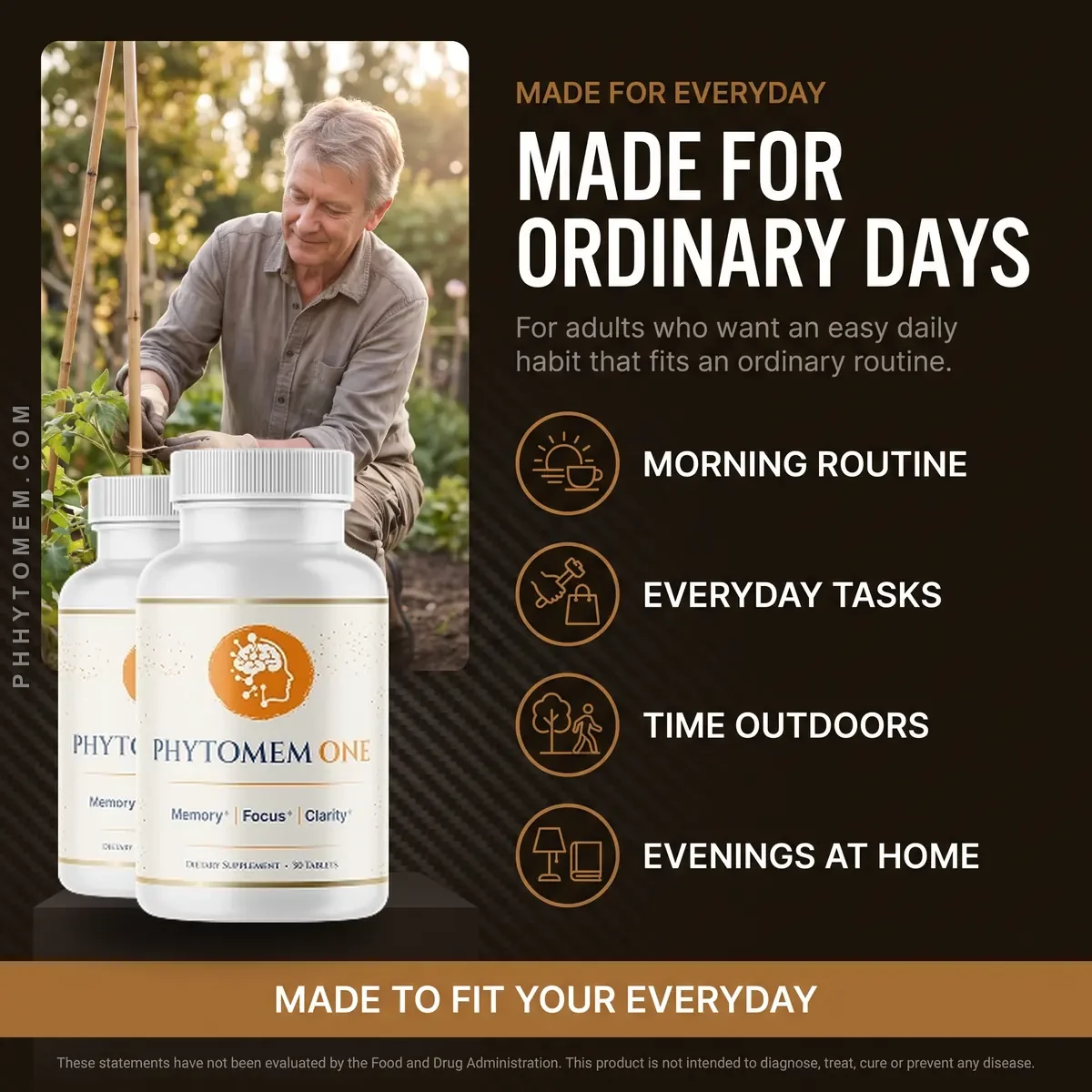
See how stimulant-free Phytomem One fits your routine →
Where do stimulant-free botanicals fit in?
Botanicals are a complement to the focus habits above, not a substitute, and never a treatment for any condition. That said, a handful of well-studied plant ingredients have long been part of the everyday-clarity conversation, and unlike caffeine they carry no jitter or crash. Here is a snapshot of the best-known ones in Phytomem One.

| Botanical | Why it is discussed | Traditional / general role |
|---|---|---|
| Saffron | Persian spice | A long tradition in mood and cognitive wellness; among the more researched botanicals in the category. |
| Morosil red orange | Polyphenol-rich citrus | A Sicilian blood-orange extract studied for its role in metabolic wellness. |
| Olive leaf | Mediterranean staple | A rich natural source of the antioxidant polyphenol oleuropein. |
| Berberine | Plant alkaloid | One of the most studied botanicals for supporting healthy metabolism, part of fuelling the brain. |
| Ceylon cinnamon | “True” cinnamon | A warm culinary spice widely studied for general metabolic wellness. |
Phytomem One brings these together in one stimulant-free daily tablet: saffron, Morosil Sicilian red orange, berberine and Ceylon cinnamon, alongside olive leaf, brown-seaweed extracts, banaba and kudzu. Because there is no caffeine, it will not spike and crash your energy the way strong coffee can. For a closer look, read our guide to saffron and berberine for brain health, or see the exact dose in Phytomem in the full ingredients section.

Make focus a daily habit
Phytomem One is a once-daily, stimulant-free tablet pairing saffron and Morosil red orange with a 10-in-1 botanical blend. The six-bottle bundle is the best value at $49 per bottle, with a 60-day guarantee.
Check today's Phytomem One pricing — from $49/bottleHow do you build a simple focus routine?
The best focus routine is the one you will actually keep, so build it one habit at a time. Stack these in order until each feels automatic:
- Choose one task for your next work block — not three, one.
- Put your phone in another room and silence non-essential alerts.
- Set a 25-minute timer and work only on that task until it rings.
- Take a real five-minute break — stand up, stretch, look out a window.
- Fix a consistent wake-up time so sleep does the quiet work for tomorrow's focus.
- Take any supplement at the same time daily — for Phytomem One, one tablet with water.
Which focus habits work fastest? An at-a-glance table
A “fast” habit is one you feel within a day; a “slow” habit reshapes your baseline over weeks. Both matter for a longer attention span. This table sorts the core habits by how quickly they help and how much effort they ask.
| Habit | Typical time to notice | Everyday effort |
|---|---|---|
| Phone out of reach, alerts off | Same day | Low |
| 25-minute timed work block | Same day | Low |
| A full night of sleep | Next day | Medium |
| 20-minute walk between tasks | Same day | Low |
| Daily attention training | Weeks | Low |
| Consistent movement over time | Weeks to months | Higher |
Consistency turns any of these into a sharper month. Botanicals build their support gradually, so most people choose a multi-month supply — compare the packages and pricing on the homepage, or read our companion guide on how to improve memory and focus naturally.

When should you talk to a doctor?
Natural focus habits are for supporting an already-healthy mind; they are not a replacement for medical care. Speak with your doctor if you are pregnant or nursing, under 18, take any medication, have a diagnosed condition, or notice attention difficulties that seriously disrupt daily life. Ongoing trouble focusing can have medical causes worth checking, and a quick conversation ensures anything you add fits safely with your care.
Frequently asked questions
How can I increase my attention span naturally?
You increase attention span naturally by training focus in short timed work blocks, protecting seven to nine hours of sleep, cutting the background distractions that fragment attention, and moving your body most days. These habits stack, and a stimulant-free botanical like Phytomem One can support the routine rather than replace it.
How long is a normal attention span for focused work?
Sustained deep focus on a single demanding task typically runs in the range of a few minutes to around 20 minutes before attention naturally dips, which is why timed work blocks with short breaks suit how the mind actually works. The exact figure varies by person, task and how rested you are.
Does reducing screen time really improve concentration?
Cutting constant notifications and task-switching removes the interruptions that reset your focus, so most people concentrate for longer once the phone is out of reach and alerts are off. It does not add focus so much as stop it leaking away.
Is Phytomem One a stimulant like caffeine?
No. Phytomem One is a stimulant-free daily botanical blend built around saffron, Morosil red orange, berberine and Ceylon cinnamon. It is meant as a gentle complement to focus habits, not a substitute for them, and it is not a treatment for any condition.
How long before I notice a longer attention span?
Removing distractions and getting one good night of sleep can help the same day, while attention training, exercise and steadier habits usually build over several weeks. Botanicals support the routine gradually, and individual results vary.
Can I lengthen focus without giving up coffee or my routine?
Yes. Most gains come from small, sustainable changes — a timed work block, phone out of sight, a consistent bedtime and a daily walk — rather than dramatic overhauls, and you can keep moderate coffee while adding a stimulant-free supplement.
Try stimulant-free Phytomem One risk-free for 60 days →
Phytomem One is a dietary supplement, not a treatment for any medical condition. These statements have not been evaluated by the Food and Drug Administration. This product is not intended to diagnose, treat, cure or prevent any disease. Always consult a qualified healthcare professional about your individual needs.
References & further reading
- National Institutes of Health, News in Health. Focus on Concentration — practical strategies for attention. newsinhealth.nih.gov/2021/09/focus-concentration
- National Center for Complementary and Integrative Health (NCCIH). Meditation and Mindfulness: What You Need To Know. nccih.nih.gov/health/meditation-and-mindfulness
- PubMed / U.S. National Library of Medicine. Physical activity, exercise and attention — research literature. pubmed.ncbi.nlm.nih.gov
- Mayo Clinic. Sleep tips: 6 steps to better sleep. mayoclinic.org/sleep/art-20048379
- Examine.com. Saffron (Crocus sativus) — evidence-based summary. examine.com/supplements/saffron
These references describe the habits and ingredients in general terms and do not constitute evidence that any product treats, cures or prevents any condition.
Keep reading: how to improve memory and focus naturally · best foods for brain health · the full Phytomem One review · back to the blog.