How to improve memory and focus naturally: the Phytomem One guide

Updated August 2026 · reviewed by the Phytomem Research Team. We are an independent information resource, not a medical provider, and this article is educational rather than medical advice.
To improve memory and focus naturally means using everyday habits — sleep, food, movement, mental challenge and stress management — and, if you choose, well-studied botanicals like saffron and Ceylon cinnamon, to help keep your mind sharp and clear (NIH NCCIH). It is about consistency over extremes, and it works alongside, not instead of, the guidance of your doctor.
The fastest route to a sharper, clearer mind, in one place.
- The goal
- Support the everyday memory, attention and clarity that let you follow a conversation, remember a name and stay on task.
- Biggest levers
- Sleep and movement matter most, closely followed by a colourful whole-food diet and regular mental challenge.
- The 20-minute rule
- A brisk 20-minute walk increases blood flow to the brain and is one of the simplest ways to sharpen focus the same day.
- Where supplements fit
- Botanicals such as saffron, Morosil red orange and berberine can support the routine, but they are not a treatment for any disease.
- Timeframe
- Sleep and a walk help the same day; broader diet and fitness changes usually show over several weeks to a few months, and results vary.
If you have ever walked into a room and forgotten why, or lost the thread of a sentence mid-way through, you have felt attention and memory in motion. For most people the aim is simply a mind that feels a little sharper, and the levers with the most influence are the ordinary ones. This guide walks through them in plain language and shows where a botanical formula like Phytomem One can play a supporting role.

What does it mean to improve memory and focus naturally?
Supporting your mind naturally is the practice of using sleep, diet, activity, mental challenge and stress management to help your brain do what it already does: encode new information, hold attention and recall what matters (Singh B et al., Br J Sports Med 2025). It is not a cure for anything; it is a set of small, repeatable choices that keep your thinking clearer day to day. Two ideas anchor everything below: consistency beats intensity, and these habits stack — each helps a little, and together they help a lot.
Why do memory and focus fade in the first place?
Attention and memory are demanding jobs, and the brain is an energy-hungry organ — it uses a large share of your daily fuel even at rest. Several ordinary factors chip away at how sharply it works: broken or too-short sleep, a diet heavy on refined food, chronic stress, too little movement, and long stretches of passive screen time that never really challenge the mind. The encouraging news is that each of those is something you can nudge in a better direction. Below are the habits with the most leverage, roughly in order of impact. If it is the foggy, unfocused feeling that bothers you most rather than recall, start instead with how to improve mental clarity naturally.
What are the most effective everyday habits?
1. Protect your sleep first
Sleep is when the brain consolidates memories and clears metabolic by-products from the day. A short or broken night blunts attention and makes recall harder the very next morning. Aim for seven to nine hours on a consistent schedule, keep screens dim in the last hour, and treat a regular wake-up time as the anchor of your whole routine. No supplement can replace what a good night of sleep does for focus (NIH NCCIH).
2. Move your body most days
Regular aerobic activity increases blood flow to the brain and, over time, supports the health of the cells and connections that underpin memory. You do not need a gym: a brisk daily walk, cycling, gardening or dancing all count. A single 20-minute walk can lift attention within the hour, and consistent movement across weeks is one of the best-studied habits for a sharper mind as you age.
3. Eat for the brain
The brain thrives on a colourful, whole-food diet: leafy greens, berries, nuts, beans, whole grains, olive oil and oily fish. These foods supply the polyphenols, healthy fats and steady energy the brain uses, while a diet heavy on refined sugar and ultra-processed food pulls in the other direction. You will find a full list in our guide to the best foods for brain health and memory.

4. Keep challenging your mind
The brain stays adaptable throughout life, and it responds to novelty. Learning a language, taking up an instrument, doing puzzles, reading widely or playing a strategy game like chess all give your mind the kind of effortful challenge that keeps it engaged. The key word is new: once something becomes automatic, add a fresh layer of difficulty.
5. Manage stress and stay connected
Chronic stress floods the body with cortisol, which over time can interfere with memory and focus. Simple decompression — a walk outdoors, slow breathing, time in nature — helps, and so does staying socially connected. Regular, meaningful conversation is itself a workout for the mind.
See how Phytomem One fits your routine →
Which nutrients are part of the conversation?
Supplements are a supplement to the habits above, not a substitute, and never a treatment for any condition. Still, a handful of botanicals have long been part of the brain-and-focus conversation. Here is a snapshot of the best-known ones, several of which appear in Phytomem One.
| Botanical | Why it is discussed | Traditional / general role |
|---|---|---|
| Saffron | Persian spice | A long tradition in mood and cognitive wellness; among the more researched botanicals in the category. |
| Morosil red orange | Polyphenol-rich citrus | A Sicilian blood-orange extract studied for its role in metabolic wellness. |
| Olive leaf | Mediterranean staple | A rich natural source of the antioxidant polyphenol oleuropein. |
| Berberine | Plant alkaloid | One of the most studied botanicals for supporting healthy metabolism, part of fuelling the brain. |
| Ceylon cinnamon | “True” cinnamon | A warm culinary spice widely studied for general metabolic wellness. |
Phytomem One brings these together in one daily tablet: saffron, Morosil Sicilian red orange, berberine and Ceylon cinnamon, alongside olive leaf, brown-seaweed extracts, banaba and kudzu. For a closer look, read our guide to saffron and berberine for brain health, or see the full ingredients section.

Make it a daily habit
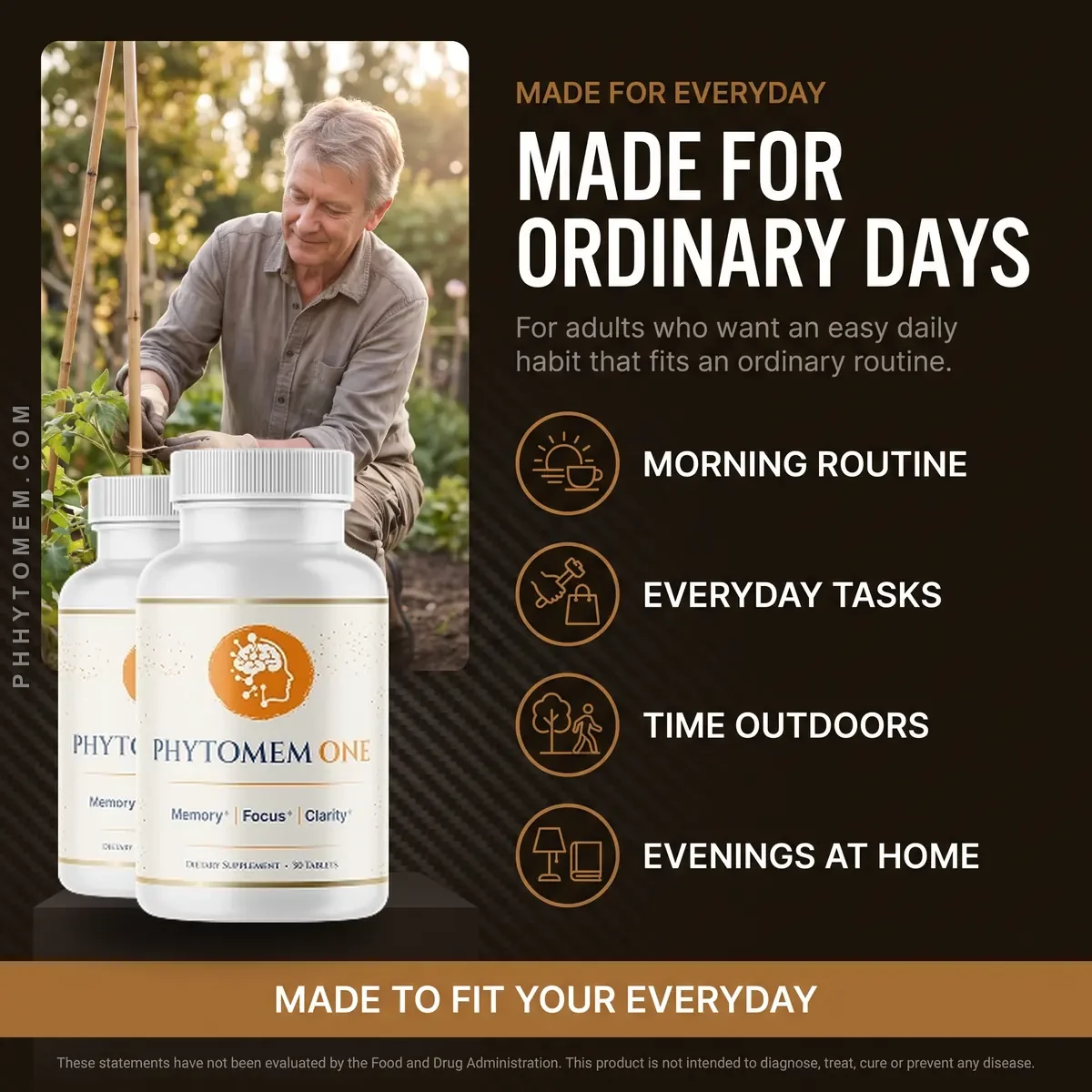
Phytomem One is a once-daily tablet pairing saffron and Morosil red orange with a 10-in-1 botanical blend. The six-bottle bundle is the best value at $49 per bottle, with free U.S. shipping and a 60-day guarantee.
Order Phytomem One — from $49/bottleHow do you build a simple daily routine?
The best routine is the one you will keep. Rather than overhauling everything at once, stack one small habit at a time until each feels automatic:
- Fix a consistent wake-up time so your sleep does the quiet work.
- Take a 20-minute walk most days, ideally outdoors.
- Add one colourful plant food to each meal.
- Learn something new for 15 minutes — a language app, an instrument, a puzzle.
- Wind down screens in the last hour before bed.
- Take any supplement at the same time daily — for Phytomem One, one tablet with water.
Which habits work fastest? An at-a-glance table
A “fast” habit is one you feel within a day; a “slow” habit reshapes your baseline over weeks. Both matter. This table sorts the core habits by how quickly they help and how much effort they ask.
| Habit | Typical time to notice | Everyday effort |
|---|---|---|
| A full night of sleep | Next day | Medium |
| 20-minute brisk walk | Same day | Low |
| Colourful whole-food meals | Days to weeks | Medium |
| Daily mental challenge | Weeks | Low |
| Stress & social routine | Weeks | Medium |
| Consistent activity over time | Weeks to months | Higher |
Consistency turns any of these into a sharper month. Botanicals build their support gradually, so most people choose a multi-month supply to avoid running out mid-routine — compare the packages and pricing on the homepage.

When should you talk to a doctor?
Natural habits are for supporting an already-healthy mind; they are not a replacement for medical care. Speak with your doctor if you are pregnant or nursing, under 18, take any medication, have a diagnosed condition, or notice persistent or worsening problems such as sudden confusion, marked memory loss or changes that interfere with daily life. A quick conversation ensures anything you add fits safely with your care. Readers doing this for an older parent may find our guide to memory boosters for seniors more directly useful.
Frequently asked questions
What does it mean to improve memory and focus naturally?
It means using everyday habits — sleep, food, movement, mental exercise and stress management — and, optionally, well-studied botanicals like saffron and Ceylon cinnamon, to help keep memory and focus sharp. It complements, rather than replaces, medical care.
Which habits help memory and focus the most?
Consistent sleep, a whole-food diet rich in colourful plants and omega-3s, regular aerobic exercise, mentally challenging activities, and managing chronic stress are the habits with the most leverage on everyday memory and focus.
Do supplements like saffron and berberine help focus?
Saffron has a long tradition in cognitive and mood wellness, and botanicals such as berberine and Ceylon cinnamon are studied for metabolic wellness that helps fuel the brain. They are a support to healthy habits, not a treatment, and medication users should ask a doctor first.
How long does it take to notice sharper focus?
A good night of sleep or a brisk walk can help focus the same day, while broader diet, fitness and habit changes usually show over several weeks to a few months. Botanicals build their support gradually, and individual results vary.
Does exercise really improve memory?
Regular aerobic activity increases blood flow to the brain and supports the health of brain cells over time. Even daily walking counts, and pairing movement with good sleep and a whole-food diet compounds the benefit.
Can I improve focus without giving up my routine?
Yes. Most gains come from stacking small, sustainable habits — a consistent bedtime, a walk after lunch, more colourful plants on the plate, and a single daily supplement — rather than dramatic overhauls.
Try Phytomem One risk-free for 60 days →
Phytomem One is a dietary supplement, not a treatment for any medical condition. These statements have not been evaluated by the Food and Drug Administration. This product is not intended to diagnose, treat, cure or prevent any disease. Always consult a qualified healthcare professional about your individual needs.
References & further reading
- National Center for Complementary and Integrative Health (NCCIH). Dietary Supplements for Cognitive Function. nccih.nih.gov/health/cognitive-function
- Examine.com. Saffron (Crocus sativus) — evidence-based summary. examine.com/supplements/saffron
- National Center for Complementary and Integrative Health (NCCIH). Cinnamon. nccih.nih.gov/health/cinnamon
- Singh B, Bennett H, Miatke A, et al. Effectiveness of exercise for improving cognition, memory and executive function: a systematic umbrella review and meta-meta-analysis. British Journal of Sports Medicine, 2025. pubmed.ncbi.nlm.nih.gov/40049759
- Examine.com. Berberine — evidence-based summary. examine.com/supplements/berberine
These references describe the ingredients and habits in general terms and do not constitute evidence that any product treats, cures or prevents any condition.
Keep reading: the best foods for brain health and memory · how saffron and berberine work · back to the Phytomem One blog · homepage.